Monuments
A closer look at the twelve stones in Joshua 4
I was recently in Auckland (in New Zealand) and had some free time, so I went for a walk to Maungakiekie (One Tree Hill). It was about a half hour walk from where I was staying to the park around the hill, and as I was walking there, I couldn’t help but notice the monument on top of the hill, and how it stood out against the skyline.
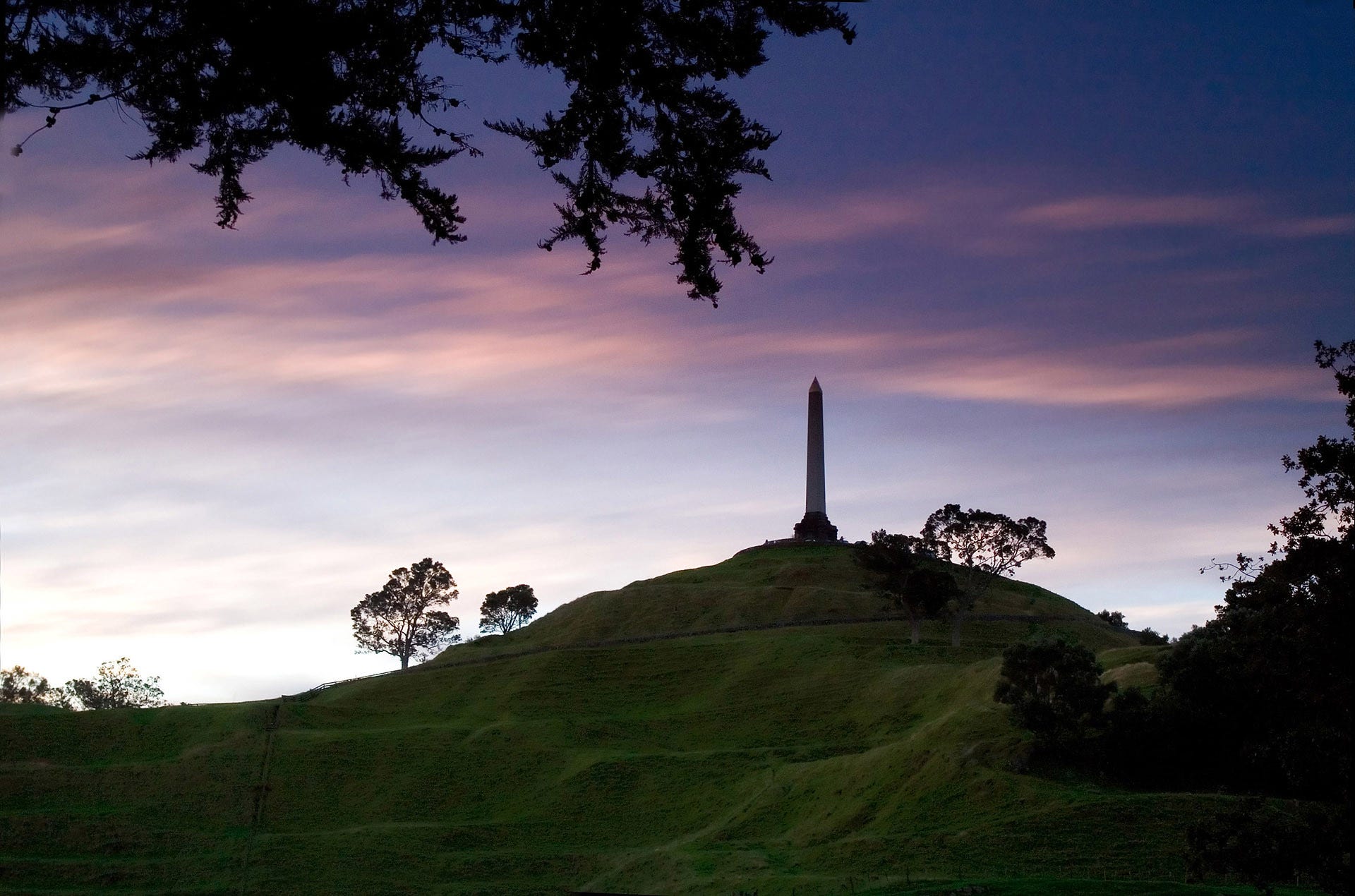
When I reached the park and climbed to the top of the hill, I took some time to read the writings on the monument and learn why it had been built and what it represented.1
This got me thinking about the whole idea of monuments, and specifically about the monument that Joshua erected after Israel had crossed the Jordan in Joshua 4. How is the monument described? What is its purpose? What kind of monuments might we erect today to serve similar purposes?
Joshua 4
Following Joshua 3’s account of YHWH’s parting the Jordan and Israel crossing over on dry ground, Joshua 4 is dedicated to the establishment of a memorial.
In my initial reading of this chapter I found the chronology somewhat confusing; it begins with “When the entire nation had finished crossing over the Jordan” (Joshua 4:1, NRSV, but similar in most English translations), but then describes events that are yet to happen during the crossing itself. Richard S. Hess provides an explanation for this:
The verb finished (Heb. tmm) does not suggest that everyone had crossed before the next event took place. It is better understood as something still taking place and translated ‘were finishing the task’. Theologically, this verb describes the complete and precise fulfilment of God’s will, as is illustrated in the next section.2
Chronology aside, the events themselves regarding the stones seem to be fairly straightforward:
YHWH instructs Joshua to take twelve stones from the Jordan (verses 2–3)
Joshua instructs twelve men to carry out these instructions (verses 4–5)
The men obediently carry out the instructions (verse 8)
Joshua “sets up” the twelves stones up in Gilgal (verse 20)
In addition, verse 9 describes Joshua setting up twelve stones in the middle of the Jordan, presumably separate to the stones described in verses 1–8.3
Throughout this chapter, there are three words used to refer to the stones:
אֶבֶן (ʾeben) – “Stone”
אוֹת (ʾôt) – “Sign”
זִכָּרוֹן (zikkārôn) – “Memorial”
In order to understand the nature of the monument in this passage, we will look a bit more closely at each of these words.
Stones
The word אֶבֶן (ʾeben), as well as related forms, is used eight times in Joshua 4, and is overwhelmingly translated simply as “stone” or “stones.” The Theological Wordbook of the Old Testament says:
The meaning of ʾeben is almost singularly “stone,” and in the cognate Semitic languages both meaning and usage are the same. Stones are common in the middle east, and the word occurs more than 275 times in the Hebrew and Aramaic of the Bible. In all but a few places, which are cited below, the meaning is simply “stone.”4
The category of stone, however, is quite a large one:
The word is used in a range of contexts indicating that אֶבֶן may refer to a foundation stone of several tons (1 Kgs 5:17 [31]) or a stone the size of a pebble (Exod 28:9).5
Given the context of the passage, it seems safe to assume that the size of the stones in question are large enough to not easily be destroyed or dismantled (in order to endure as a monument), but small enough that a human can carry them—on their shoulder (or upper back), no less.6
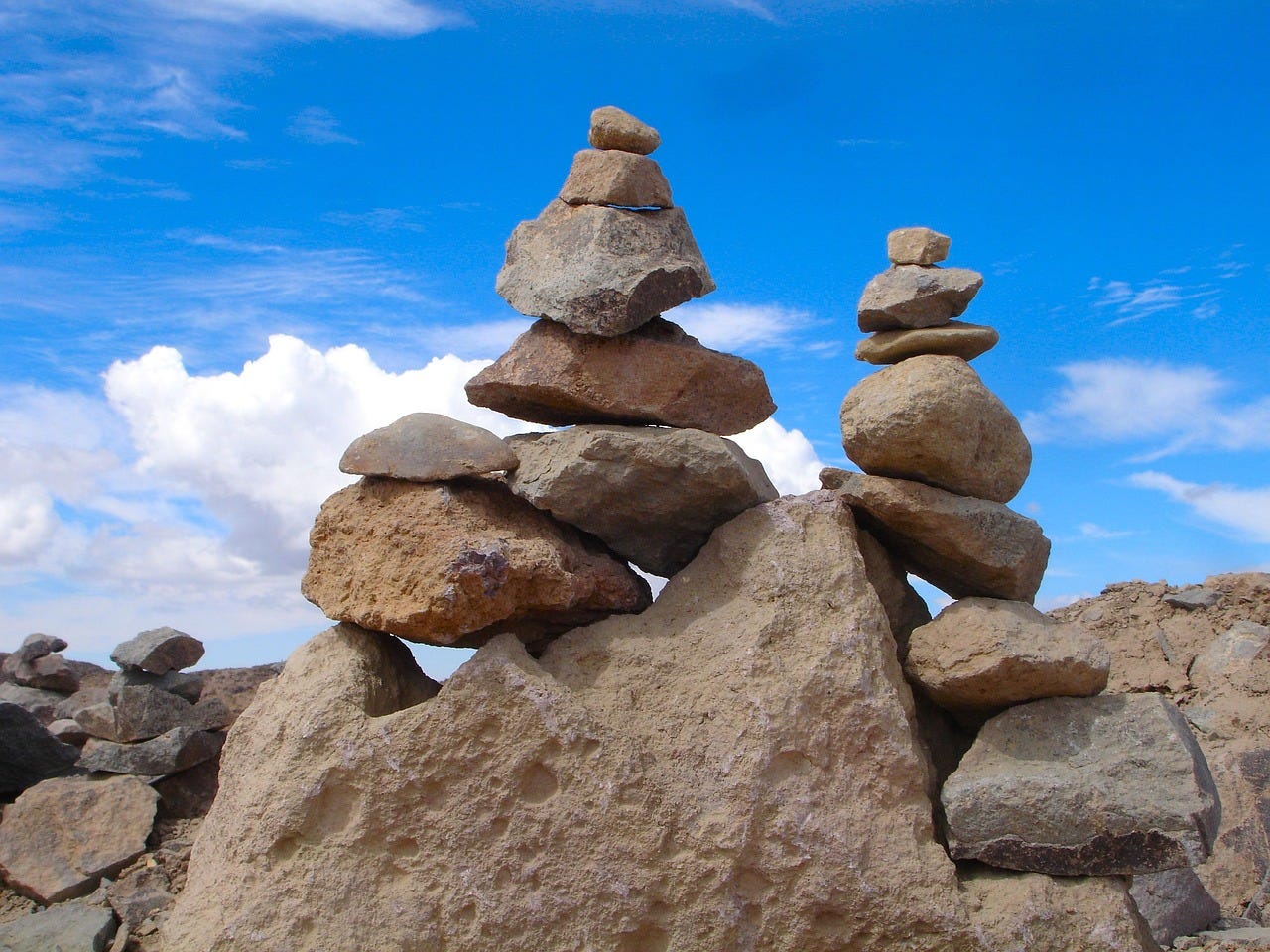
Another thing that is interesting to note is that the word אֶבֶן does not carry any inherent meaning related to being a monument, memorial, or sign. In verses 2, 5, 8, and 9 the word is used to refer to the stones as stones. However in verses 6, 7, 20, and 21, the word (in a form translated as “those stones” or “these stones”) is used to refer to the specific twelve stones that have been established as a monument.
The description of these specific stones as a “sign” and a “memorial” in verses 6 and 7 give them special significance so that when referencing them as “those stones” or “these stones” in verses 20 and 21, the full meaning of the phrase might be something closer to “these specific stones which have been set up as a sign and a memorial.”
A sign
In verses 5–6, Joshua instructs twelve men to take the stones from the Jordan, saying to do this “so that this may be a sign among you” (Joshua 4:6, NRSV). The word most commonly translated as “sign” (but sometimes “symbol” or “reminder”) is the word אוֹת (ʾôt). The Theological Wordbook of the Old Testament gives several other definitions and acknowledges the broad range of meaning:
אוֹת (ʾôt) sign, mark, token, ensign, standard, miracle, miraculous sign, proof, warning.
This is the general word for “sign,” and it covers the entire range of the English term and the Greek word sēmeion.7
I’m not familiar with the Greek word sēmeion, but I have a decent understanding of the range of ways in which the English word “sign” can be used. In light of the definitions above, I would suggest that a broad understanding of what “sign” means could be “an event or object that communicates something.” By describing the stones as “a sign”, Joshua is essentially saying “these stones mean something.”
There are other aspects of a sign that could be intended by the use of this word, but I think we find those aspects are more prominent in another word used in this passage: “memorial”.
A memorial
After describing the stones as a “sign”, Joshua gives the first of two explanations of what the stones signify (more on that below), and then concludes at the end of verse 7 with “So these stones shall be to the Israelites a memorial forever.” This is where we find the third word used to describe the stones: זִכָּרוֹן (zikkārôn), defined as:
זִכָּרוֹן (zikkārôn). Memorial, reminder, token, record. The zikkārôn is an object or act which brings something else to mind or which represents something else.8
If calling the stones “a sign” indicates that they mean something, and are supposed to communicate a specific message, calling the stones “a memorial” specifies that what the stones are meant to communicate is the remembrance of a specific occurrence (in this case, YHWH stopping the waters of the Jordan). The stones serve as a reminder of this event.
A sign and a memorial?
Given the definition of “memorial,” it might seem that the word “sign” is a tad unnecessary when describing the twelve stones, but the combined used of both “sign” and “memorial” add depth to the meaning of the stones in at least two ways.
First, the use of “sign” in verse 6 and “memorial” in verse 7 may form an inclusio around the rest of the those verses.9 An inclusio is:
A literary device that repeats words or themes at the beginning and end of a section. The repetition brackets the section.10
In this case, the explanation of what the stones mean in verse 7 is bracketed by the description of the stones as a sign and a memorial. This frames the explanation of the stones’ signficance within the context of the stones having a specific purpose, and that purpose being remembrance. Admittedly the question at the end of verse 6—“‘What do those stones mean to you?”—provides a similar function, so the inclusio is not as prominent in light of this.
Note that the same combination of words is used also in Exodus 13:9 when describing the festival of unleavened bread. This is not an inclusio but an instance of parallelism that serves to reinforce the point. However this is an instance where both “sign” and “memorial” are used for literary effect to underscore the remembrance of YHWH’s deliverance.
Second, the use of “sign” in verse 6 has strong links to the Exodus. Within the Exodus account, the same word for “sign” (אוֹת) is used repeatedly to describe YHWH’s works against Egypt that result in Israel’s liberation (Exodus 7:3, 8:23, 10:1, 10:2, 12:13).11 It is also used in Numbers and Deuteronomy when referring to YHWH’s works, and specifically to those in Egypt (e.g. Num 14:22; Deut 4:34, 6:22, 7:19, 11:3, 26:8, 34:11).
Surely the use of this term in Joshua 4 is no accident, as this passage has several other references to the Exodus. The most notable reference is the explicit comparison to the parting of the Red Sea in verse 23, but we also find that the “tenth day of the first month” (verse 19) is the same day of the year that the passover lamb is prepared.12 There is an intentional link to the Exodus event here, as well as a parallel link between Moses and Joshua.13 Note also that Moses similarly erected twelve pillars in Exodus 24:4.
The use of both “sign” and “memorial” to describe the twelve stones can be seen as ascribing a significance to the stones that is rooted in remembering YHWH’s faithfulness, not only on this occasion, but throughout Israel’s history as well.
What do the stones mean?
Finally, we arrive at the meaning of the stones. What do they represent? What exactly is Israel supposed to remember when they look at them?
Right after giving the instructions to take the stones, Joshua answers these questions in verses 6 and 7:
[Take the stones] 6 so that this may be a sign among you. When your children ask in time to come, ‘What do those stones mean to you?’ 7 then you shall tell them that the waters of the Jordan were cut off in front of the ark of the covenant of the Lord. When it crossed over the Jordan, the waters of the Jordan were cut off. So these stones shall be to the Israelites a memorial forever.”
The answer is clear: the stones are a reminder that the waters of the Jordan were cut off when Israel crossed the Jordan with the ark. While not explicitly mentioned in this passage, I think it’s safe to assume that Israel is also supposed to remember that it was God who caused the waters of the Jordan to be cut off.
Note that Joshua doesn’t provide this answer to the Israelites asking “What do these stones mean to you?”, but to the children of the Israelites asking the same question. This isn’t just a reminder for the present generation who witnessed the event itself, this is a reminder for generations to come!
When the children, grandchildren, and great-grandchildren of the Israelites who crossed the Jordan ask their parents what those twelve stones in Gilgal mean, they are to tell their children about the time when the covenant-keeping God of Israel cut off the waters of the Jordan at this very spot to allow Israel to enter the promised land.
This isn’t all the stones represent though; in verses 21–24, after the stones have been set up in Gilgal, Joshua again tells the Israelites what the stones mean:
20 Those twelve stones, which they had taken out of the Jordan, Joshua set up in Gilgal, 21 saying to the Israelites, “When your children ask their parents in time to come, ‘What do these stones mean?’ 22 then you shall let your children know, ‘Israel crossed over the Jordan here on dry ground.’ 23 For the Lord your God dried up the waters of the Jordan for you until you crossed over…
The first part of this is similar to verses 6 and 7: the meaning is framed in response to the question of the children, and the answer is that the stones are a sign to remember that Israel crossed over the Jordan on dry ground as the waters were dried up. But Joshua doesn’t stop there:
…as the Lord your God did to the Red Sea, which he dried up for us until we crossed over…
Unlike verse 7, verse 23 explicitly credits God for the miracle, and then goes on to remind Israel of their own history, that this is the same God who parted the Red Sea. This provides a neat little parallel regarding the children. The same Israelites who here are charged with teaching their children about God parting the Jordan, would’ve learned from their own parents about God parting the Red Sea.
Finally, Joshua rounds out the meaning of the stones with:
24 …so that all the peoples of the earth may know that the hand of the Lord is mighty, and so that you may fear the Lord your God forever.”
Not only do the stones function as a sign and a memorial for Israel to remember God’s power and faithfulness, but this act of remembering will have effects on Israel themselves and on the nations of the earth. In remembering, Israel will fear YHWH forever,14 and in remembering, Israel will cause the peoples of the earth to know of God’s power.
The function of the stones
So, in summary, the stones are to:
Remind the Israelites and their descendants of when God dried up the Jordan and caused the people and the ark to cross over on dry ground
Remind the Israelites and their descendants that the same God also dried up the Red Sea to allow their ancestors to cross it
Cause the Israelites to fear and worship YHWH forever
Cause the nations to know that the hand of YHWH is mighty
In addition to the stated purpose of the stones, I wonder if we can infer a few more functions of the stones based on their inherent characteristics.
First of all, the stones are intended to be publicly visible; this is an important distinction compared to other signs or remembrances (for example, circumcision). The pile of stones is a publicly visible sign so that Israel might be prompted to remember whenever they see them. If the stones were not easily visible, or if they were in a non-public location, then they would hardly give many Israelites the cause to remember.
Similarly, for the sign to be a “memorial forever” (or at least a long time), it needed to endure, to be unlikely to be destroyed or dismantled. Stones, therefore, are a suitable choice. While fairly durable, stones (at least stones small enough to be carried by humans) are not indestructable. It stands to reason that eventually—whether years, decades, or centuries after the creation of the monument—the physical monument will cease to exist.15 Gordon H. Matties acknowledges this and suggests that over time, the repetition of the story associated with the stones takes the place of the stones themselves:
Over time, centuries after the composition of this text, the stones would no longer be visible, and thus the story of the crossing takes the place of the stones. This transformation of the memorial stones into narrative allows future generations to identify with the crossing (cf. Deut 5:2-3). The story becomes the testimony to later readers of the wonders that the Lord will perform (3:5).16
Lastly, note that the placement of the stones is in Gilgal—the stones are amongst the Israelites (cf. “a sign among you”, verse 6). Initially the stones are present in the encampment following the crossing, providing an immediate reminder of the crossing of the Jordan that is already fresh in everyone’s memories. As the Israelites settle the promised land and Gilgal becomes part of the land of Israel, these stones remain visible as a reminder for any Israelites who should chance to see them.
Modern-day stones
How might we embody a practice similar to the monument in Joshua 4 today? What kinds of things can we do to provide signs and memorials that will:
Remind us and our descendants of specific instances of God’s faithfulness
Cause us to fear and worship God forever
Cause other people to know that God is mighty
Be visible and enduring
Be among people, both Christian and not
The individualistic nature of Western society (at least with regard to land ownership) means that physical monuments in shared places is not particularly feasible, so what other options are there? I can only think of a couple that provide most of the functions above, but I’m sure there are others I haven’t thought about, so please feel free to comment if you think of any.
First, we could erect monuments at our own homes. Using materials that are related to or represent work that God has done in our lives, we could create physical and visible monuments. If we were to create such monuments and place them in prominent positions in our front lawns, I have no doubt that they would serve many of the functions listed above. We would be prompted to remembrance every time we left the house, and our children would likely ask about them, as would friends, family, and neighbours.
Second, we could get tattoos with meaningful imagery related to God’s faithfulness in our lives. I know that the practive of getting a tattoo is a debated topic amongst Christians, and I’m not advocating in favour of getting a tattoo, but they do provide most of the same functions as the twelve stones. They are visible (if they are somewhere like the forearm), they are enduring, the owner of the tattoo will continually be reminded of the tattoo’s meaning, and others are likely to ask the meaning of the tatoo. And unlike a monument in the garden, a tattoo travels with its owner whereever its owner goes—this arguably meets the aim of being among people (Christian and not) better than a fixed monument.
There are, of course, many other ways that we can engage in remembrance, but most of them do not fulfil all the functions of the twelve stones listed above. E.g. things inside the house are not publicly visible, clothing or stickers on cars are not enduring, and a simple statue using well-known Christian imagery does not prompt the non-believer to ask about its meaning. All of these are well and good, they just don’t provide as close an analogy to the monument in Joshua 4.
Conclusion
The act of creating a monument, a sign or memorial for remembrance, is not a common practice today. As we’ve seen in Joshua 4, the benefits of such a practice are significant, both for ourselves and for others. Perhaps this is a practice that we should consider embracing anew.
Robert. L Hubbard, after reflecting on various monuments in Joshua and the role of Scripture as a monument to the current generation, ends with the following quote:
The danger of such historical Alzheimers threatens each new generation but particularly our postmodern one. Thus, a new millennium summons all of us to be ready to give an answer to anyone who asks, “Say, what do these stones mean?”17
It is our responsibility as Christians, not only to provide an answer to that question, but to do what we can to ensure that the question is asked in the first place.
Post-script – Out of scope
As I was writing this I found many avenues of research tempting me to explore them, but in order to prevent this post from becoming excessively long, I have managed (with great self-restraint) to put them to one side, for the time being at least. These include:
Other monuments in Joshua and throughout the Bible
Various words not used to describe the monument in Joshua 4 (e.g. “pillar” which is used elsewhere in the Bible for monuments)
The practice of establishing altars and how this related to monuments
The symbolism between the twelve tribes of Israel and the twelve stones of the monument, and what implications this might have for monuments today
How the stones may have born witness themselves even without anyone speaking about them18
The discovery of a twelve-stone monument at Mt. Karkom19
Whether the twelve-stone monument at Gilgal still exists to this day20
While I am unlikely at this stage to continue research in these areas, I thought I’d list them here for completeness.
This seems to be a very safe account of the monument’s meaning. A more in-depth discussion into its meaning can be found here: https://ahi.auckland.ac.nz/2021/07/22/mere-cold-stone-the-different-meanings-of-the-one-tree-hill-obelisk/.
Richard S. Hess, Joshua: An Introduction and Commentary, TOTC 6, (Downers Grove: InterVarsity Press, 1996), 118.
The NIV seems to be alone in interpreting verse 9 as referring to the same stones, not a separate monument. Hess provides an argument for this in Hess, Joshua, 120.
Robert L. Alden, “אֶבֶן,” TWOT, 7–8, 7.
Andrew E. Hill, “אֶבֶן,” NIDOTTE, 1:248–250, 249. For a more comprehensive list of different types of stones that אֶבֶן is used to refer to, see A. S. van der Woude, “צוּר,” TLOT, 1067–1071.
We may remove the upper limit on the size of the stones if we assume divine strength is given to the men who lifted the stones, but there is no implicit or explicit textual evidence that indicates this.
Robert L. Alden, “אָוָה,” TWOT, 18–19, 18.
Andrew Bowling, “זָכַר,” TWOT, 241–243, 242.
I might be overreaching in finding an inclusio here. While some commentators, such as Hess, recognise the chiastic structure of verses 6 and 7, they do not specifically identify an inclusio formed by “sign” and “memorial” (Hess, Joshua, 119). Similarly, Hawk notes the symmetry within verse 7 as well as the double designation of the stones as “sign” and “memorial” but stops short of identifying them as the frame for verse 7 in L. Daniel Hawk, Joshua, Berit Olam (Collegeville: Liturgical Press, 2000), 69.
Douglas Mangum, The Lexham Glossary of Theology, (Bellingham: Lexham Press, 2014).
These are more often referred to as “plagues” even though the text uses the term “sign” more often than “plague”, especially so if counting the references in Numbers and Deuteronomy as well.
Hawk, Joshua, 72–73.
Trent C. Butler, Joshua 1–12, 2nd ed., WBC 7a (Nashville: Thomas Nelson, 1999), 312.
In the Bible fear can be used to describe reverence, respect, and worship, as well as terror. For a detailed explanation of the different uses of the term “fear”, see M. V. Van Pelt, W. C. Kaiser, Jr., “יָרֵא,” NIDOTTE, 527–533.
The monument in the middle of the Jordan river (verse 9) is explicitly described as “there to this day”, but the monument set up at Gilgal receives no such description.
Gordon H. Matties, Joshua: Believers Church Bible Commentary, Believers Church Bible Commentary Series (Scottdale: Herald Press, 2012), 95.
Robert L. Hubbard, “‘What Do These Stones Mean?’: Biblical Theology and a Motif in Joshua,” Bulletin for Biblical Research 11 (2001): 1–26, 26.
See Hubbard, “‘What Do These Stones Mean?’,” 11–12.